Another chunk of songs for your Solstice enjoyment!
We'll start with something more serious. This one was a suggestion from a reader (onelittlepagan) - a Paganized version of "In the Bleak Midwinter" by Craig Olson. The images of an actual Solstice celebration are beautiful. What a lovely home! Thanks for sharing, onelittlepagan! I had only ever heard the Christian version and this cover, I find, works well.
How about a song about nissers, spirits from Norway and Denmark who are basically gnomes? They've become associated with both Christmas and Solstice. Many families leave porridge with a pat of butter out for them during the holidays. Perhaps nissers are in Santa's spiritual DNA? I wouldn't discount it. I don't know if I have any Norwegian blood in me (if I do, it's from a very, very long time ago...) but my husband does. I wonder if there are nissers around, just waiting for us to befriend them? Anyway, this adorable little song is called "Jeg Tror Der Findes Nisser" ("I Think There are Gnomes") by Thomas Kjellerup.
And while we're dealing with European spirits, what Solstice would be complete without The Krampus Christmas Song? While Nissers can have a malicious streak if crossed, the Krampus is a bit terrifying. Meeting him and his birch whipping rod is way worse than getting coal. Krampus is a huge tradition in parts of Europe (and even some parts of America). On a certain day of the year, several adults will dress up as Krampus and roam the streets to frighten children with old chains. Some even lightly hit people. Sounds fun, to me!
( For My LJ and FB Friends: http://adfcatprints.blogspot.com/ )
Showing posts with label history. Show all posts
Showing posts with label history. Show all posts
Sunday, December 12, 2010

Friday, November 5, 2010
In Which I Struggle Through Magic 1
I think I'm finished with exit question 1 of Magic 1. For now anyway.
I now believe that one reason I stalled on the essays is because the first question is, in my opinion, worded so awkwardly. "Discuss the importance of the action of the magico-religious function as it is seen within the context of the general Indo-European culture." Over the past few months, as I read book after book on magic, I would return to the first exit question to see if I felt confident to try it. It always felt jagged going into my brain. It always sounded convoluted coming out of my mouth.
I still worry that I don't know enough to answer the questions. I'm probably over-thinking things, but I realized that I now know a lot more about the Greek and Roman perceptions of magic than the Celtic. I tried to find some old Irish legal manuscripts dealing with magic, but they either haven't been translated yet or are buried in another law text concerned with something more general. I know from prior reading that the concept of a witch or a sorcerer who practices dark magic exists in Irish lore, but I don't know if those aspects are demonized through Christianity or not. If the ancient Greek and Roman Pagans allowed for conceptions of marginal, ethically questionable magicians, it's certainly possible that the ancient Celts felt the same way. That said, the Greeks and Romans were afraid of people who threatened the social balance. The Celts, on the other hand, have examples of public cursing resulting in the fall of kings - major social change! However, the cursing is usually justified because it was the king himself who threw the system out of balance!
Raaarg. I have a headache. At least I'm finally starting my essays.
( For My LJ Friends: http://adfcatprints.blogspot.com/ )
I now believe that one reason I stalled on the essays is because the first question is, in my opinion, worded so awkwardly. "Discuss the importance of the action of the magico-religious function as it is seen within the context of the general Indo-European culture." Over the past few months, as I read book after book on magic, I would return to the first exit question to see if I felt confident to try it. It always felt jagged going into my brain. It always sounded convoluted coming out of my mouth.
I still worry that I don't know enough to answer the questions. I'm probably over-thinking things, but I realized that I now know a lot more about the Greek and Roman perceptions of magic than the Celtic. I tried to find some old Irish legal manuscripts dealing with magic, but they either haven't been translated yet or are buried in another law text concerned with something more general. I know from prior reading that the concept of a witch or a sorcerer who practices dark magic exists in Irish lore, but I don't know if those aspects are demonized through Christianity or not. If the ancient Greek and Roman Pagans allowed for conceptions of marginal, ethically questionable magicians, it's certainly possible that the ancient Celts felt the same way. That said, the Greeks and Romans were afraid of people who threatened the social balance. The Celts, on the other hand, have examples of public cursing resulting in the fall of kings - major social change! However, the cursing is usually justified because it was the king himself who threw the system out of balance!
Raaarg. I have a headache. At least I'm finally starting my essays.
( For My LJ Friends: http://adfcatprints.blogspot.com/ )
Tuesday, October 12, 2010
The Secret of Kells - A Review
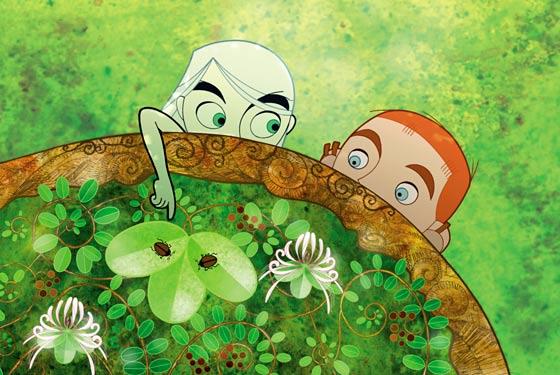
The story is about Brendan, a young brother in the Abbey of Kells in Ireland. His uncle, the Abbot, forbids Brendan from leaving the abbey and insists that he helps fortify the walls in preparation for the impending Viking raids. When the illuminator, Brother Aidan, arrives with his cat and unfinished manuscript, Brendan is suddenly encouraged to explore his more creative side and pay more attention to the natural world - which Aidan claims can teach more than any book. When asked to fetch an ingredient for ink, Brendan encounters the wolf spirit Aisling who befriends and helps him throughout the story.
Despite the presence of Christianity, the Pagan world is still alive in "The Secret of Kells." The Vikings are referred to as Pagans (which they were at this time). On some levels, the portrayal of the Vikings was unfortunate as they were shown as dark, almost infernal monsters. As they invade, one of them slashes through a cross - a scene that even made me sit up. One must remember, though, that the Irish probably saw the invaders as monstrous. Cromm Crúaich, a dubious Irish deity, is also in the film. There is mention of him in Irish lore - mostly in association with St. Patrick. Cromm is known for demanding the sacrifice of children for a good harvest. He is a very negative, demonic being in "The Secret of Kells." He's portrayed as a snake who, once dealt with, is drawn as an ouroboros - one of many spiraling symbols in the movie. What could be a negative portrayal of Paganism is balanced by the sidhe Aisling. She is the protector of the forest, a shape-shifter who, while friendly with Brendan, is also a hunter and a killer as a wolf. Aisling, to me, represents one of the best portrayals of a Pagan deity in modern culture. She is mischievous, powerful, and ageless yet benevolent to the deserving, and possessing of her own faults and weaknesses.

I highly recommend this movie to anyone who loves Ireland, mythology, or a good story. There are possibly some frightening scenes for children, so I recommend that parents watch it first if you're uncertain. If your child wasn't bothered by Disney's "The Princess and the Frog," he or she will probably love "The Secret of Kells." If you're concerned that your son or daughter will come away from the film with a poor impression of the Vikings, make sure to expose them to "How to Train Your Dragon" for a more positive representation.
( For My LJ Friends: http://adfcatprints.blogspot.com/ )
Monday, September 6, 2010
Woman Power!
Here's an amusing if incredibly corny music video devoted to Boudicca. Supposedly it's from a British show called Horrible Histories. I thought my fellow Celtophiles would appreciate it. ;)
( For My LJ Friends: http://adfcatprints.blogspot.com/ )
Sunday, August 29, 2010
On the Evolution of Magic

I'm not sure what to assume about the Celts in their many tribes. We know the Druids and the common folk practiced magic of varying degrees, and yet there is still the concept of the horrible witch - the other apart from the Druid. She (or he, I suppose) practiced wicked spells and was feared (but usually bested in the end). Was this a carryover from Christian fear, another way to view deities of death and decay, or did the Celts categorize magic as good and bad; endorsed and prohibited?
Some people have this idea that the witch of ancient times was really once a respected wise woman or man. That is true for some periods, but not all. And the witches in the stories are not healers - they are quite the opposite! Many in our communities today would also ostracize and perhaps even persecute someone who practiced magic for immoral reasons such as stealing another's property. Thankfully, it seems most Pagans do not aim for such roles. A normal person detests the wicked witches in the lore - lore that may be propaganda against the innocent practitioners of folk magic from an older, once endorsed religion.
When we look back at magic and how it has been perceived through the years, it is complicated and depends on the time and the place. It also depends on who you talk to. Magical history is not so cut and dry as some would have us believe.
( For My LJ Friends: http://adfcatprints.blogspot.com/ )
Wednesday, August 18, 2010
Rolling in Books
A new book arrived for me in the mail today: Magic in the Ancient World by Fritz Graf. It's recommended reading for Magic 1 in ADF's Initiate Program. I've read many titles about the history and folklore of magic in Europe - mostly focusing on the north-eastern parts. This latest book focuses on the Mediterranean world. All I know about magic from Greece and Rome is the mythological side - the famous witches like Circe and Medea. I'm excited to delve into it... as soon as I finish Celtic Heritage: Ancient Tradition in Ireland and Wales by Rees and Rees towards my Indo-European Mythology class.
I've also been reading from my massive art history book every night. I finished the chapter on the Egyptians a couple nights ago and am about to explore Aegean art.
Aaaaand while doing all of that, I also picked up The Lord of the Rings: The Fellowship of the Ring finally. I read and immensely enjoyed The Hobbit when I was in fifth or sixth grade, and I always meant to read the trilogy... I'm loving it so far!
( For My LJ Friends: http://adfcatprints.blogspot.com/ )
I've also been reading from my massive art history book every night. I finished the chapter on the Egyptians a couple nights ago and am about to explore Aegean art.
Aaaaand while doing all of that, I also picked up The Lord of the Rings: The Fellowship of the Ring finally. I read and immensely enjoyed The Hobbit when I was in fifth or sixth grade, and I always meant to read the trilogy... I'm loving it so far!
( For My LJ Friends: http://adfcatprints.blogspot.com/ )
Tuesday, August 10, 2010
The Moon in Modern Druidism

I'll begin by looking at the ancient Celts. As always, it is important to note that we have little information on what the ancient Celts believed due to a limited amount of pre-Christian documentation. Most of what is known comes from artifacts, the contemporary writing of antagonistic leaders or outsiders, and Christianized Celts. Details from the last two sources, especially, must be taken with a grain of salt.
Pliny the Elder wrote about the Gaulish Druids. His work includes the famous piece about Druids harvesting mistletoe on the 6th day of the moon (Ellis, Celts 54). Jean Markale analyzed the symbolism of the harvest ritual, noting that the sickle used to cut the plant would have been reminiscent of the crescent moon (Markale 131). Modern Druids from the Henge of Keltria equate this with the first quarter and celebrate the Mistletoe rite on such evenings. They explain that "mistletoe was known as `all heal,'" and take advantage of such evenings to perform remedial ceremonies. They have a second lunar ritual, the Vervain Rites.
Our other lunar rite is the Vervain Rite. The time of this rite was also chosen from classical descriptions of ancient Druidic practices. It was written that vervain was gathered when neither sun nor moon were in the sky. This occurs sometime during each night, except when the moon is full. We generally celebrate this around the 3rd quarter. This gives ample time for the rite during the evening hours. It also places this rite opposite the Mistletoe Rite in the lunar cycle. Vervain is said to be of aid in working magic. Thus, the Vervain Rite is our time for working magic. The purpose of magic in a Druidic sense is more like prayer. We work magic to help effect change in our lives. Druidic magic may involve contemplation, meditation, ritual or ecstatic dance (The Henge of Keltria FAQ).Pliny's writing aside, there is more evidence that the moon was important to the ancient Celts. The Welsh Goddess Arianrhod may have been a lunar deity. Some look to Proto-Celtic linguistics and argue that her name means silver wheel - an obvious reference to the moon (Wikipedia). Others are less convinced due to the variability of her name (Mary Jones).
Cerridwen is another possible Welsh deity with lunar associations. Etymologically speaking, her name may mean "bent white one" (Mary Jones), a possible reference to the crescent moon. When considering the symbolism of her transformations, a lunar link could be possible.
The Coligny Calendar may be the most concrete example we have of lunar observation among the ancient Celtic tribes.
Produced before the Roman conquest of Gaul, this calendar is far more elaborate than the rudimentary Julian calendar and has a highly sophisticated five-year synchronisation of lunation with the solar year (Ellis, Druids 230).Peter Berresford Ellis also notes that Caesar and Pliny the Elder both commented on how the Gauls measured time according to nights and the moon.
Thus we have strong evidence for the moon as a time piece, but less on other ritual or magical significance. I am assuming that Carmina Gadelica will have more moon lore, albeit Christianized. The moon continued to play an important role in surviving folk magic which has inspired a plethora of modern magical traditions. The moon seems central to magical thought and I am hopeful to learn more.
Works Cited
Aranrhod ferch Don. 2009. Mary Jones' Celtic Encyclopedia. 10 Aug. 2010
<http://www.maryjones.us/jce/cerridwen.html>.
Arianrhod. 13 April 2010. Wikipedia. 10 Aug. 2010 <http://en.wikipedia.org/wiki/Arianrhod>
<http://www.maryjones.us/jce/cerridwen.html>.
Arianrhod. 13 April 2010. Wikipedia. 10 Aug. 2010 <http://en.wikipedia.org/wiki/Arianrhod>
Berresford, Ellis. The Celts A History. New York: Carroll and Graf, 2004.
---. A Brief History of the Druids. New York: Carroll and Graf, 2002.
Bonewits, Isaac. "Questions and Answers about ADF." Ár nDraíocht Féin. 10 Aug. 2010
<http://www.adf.org/about/basics/qa.html>.
Cerridwen. 2004. Mary Jones' Celtic Encyclopedia. 10 Aug. 2010
<http://www.maryjones.us/jce/cerridwen.html>.
<http://www.adf.org/about/basics/qa.html>.
Cerridwen. 2004. Mary Jones' Celtic Encyclopedia. 10 Aug. 2010
<http://www.maryjones.us/jce/cerridwen.html>.
Frequently Asked Questions. The Henge of Keltria. 10 Aug. 2010
Markale, Jean. The Druids Celtic Priests of Nature. Rochester: Inner Traditions Int., 1999.
( For My LJ Friends: http://adfcatprints.blogspot.com/ )
Friday, July 23, 2010
Do you know what this is?

( For My LJ Friends: http://adfcatprints.blogspot.com/ )
Tuesday, July 6, 2010
Mushrooms in my Garden
I've got a few tiny mushrooms in my garden. According to everything we've been reading, the veggies are safe and the mushrooms can indicate good soil and benefit the plants. The shrooms themselves are not edible but the plants will not be contaminated. We think they're conocybe albipes. Pretty neat!
In other news, my interest in herbalism has been resurrected. I've been attempting to study it more. I want to learn more about how the Celts thought about and interacted with certain plants. I'm looking for good source material. I've been meaning to read Carmina Gadelica and I know there will be some in that. But what else? I read a really great essay by Erynn Rowan Laurie called "Goddess of the Growing Green: Airmid of Ireland." It really inspired me. While at Alex Bay, I found a piece of driftwood and I'm thinking of using it to create an image of Airmid for a garden shrine. I already made a doll of Airmid, but she isn't suited to the outdoors.

How many of you are involved in herbalism? Any tips or resources you can recommend?
( For My LJ Friends: http://adfcatprints.blogspot.com/ )
In other news, my interest in herbalism has been resurrected. I've been attempting to study it more. I want to learn more about how the Celts thought about and interacted with certain plants. I'm looking for good source material. I've been meaning to read Carmina Gadelica and I know there will be some in that. But what else? I read a really great essay by Erynn Rowan Laurie called "Goddess of the Growing Green: Airmid of Ireland." It really inspired me. While at Alex Bay, I found a piece of driftwood and I'm thinking of using it to create an image of Airmid for a garden shrine. I already made a doll of Airmid, but she isn't suited to the outdoors.

This is an incomplete photo... Her shroud has more color now. :D
( For My LJ Friends: http://adfcatprints.blogspot.com/ )
Sunday, July 4, 2010
4th of July
The latest post on The Wild Hunt inspired me. Today I did a formal ritual to honor, well, the spirit of America*. Most people who know me realize I'm not the most patriotic person in the world. I'm proud of my country, but not blind to its offenses. I also don't fly a million little flags around my yard like some of my neighbors **. That said, I'm not afraid to say that I feel lucky to live where I live. I read a lot of environmental and human rights news and, frankly, so many people have it way worse than us. We have our faults, that's for sure, but at least most of us are relatively comfortable and, well, safe! It's a shame that we have corporations who exploit developing nations and our own environment, and it's a shame that some of our ancestors did unspeakable things to the indigenous people who lived here first, but there's also a lot of good in America and I can think of that and celebrate it today.
Just as in my ritual, let me post it to my blog:
Hail to the spirits of America!
Hail to its Nature Spirits! Hail to the high-flying, majestic bald eagle! Hail to the forest turkey! Hail to the river otters, moose, white tailed deer, squirrels, chipmunks, black bears, mountain lions, wolves, and bobcats! Hail to the kangaroo rats, the coyotes, the scorpions, and roadrunners. Hail to the great blue herons, the salmon, the monarch butterflies, the black widow spiders, and the alligators. Hail to the sea turtles, the dolphins, the tuna, and the pelicans. Hail to the ants, the bees, and the bats! Hail to the unseen spirits who were here first and who came over with our ancestors! Hail to you all and may we live in better harmony with you!
Hail to America's ancestors! Hail to the Native American ancestors! May we grow in friendship. Hail to our immigrant ancestors! May we remember where we came from. Hail to the friends and family we knew in America, and hail to those who fought for our country - especially those whose intentions and actions were honorable. May we learn from your triumphs and mistakes.
Hail to the Gods of America! Hail to the Gods of the Native Americans, and hail to the Gods of our ancestors! Hail to Lady Liberty! May we bring honor to you in all we say and do.
May we admit to our faults and work to improve them. May we help the less fortunate, and welcome them to our country. May we celebrate our diversity and learn to live together in peace. May we develop better technologies so that we can live in harmony with nature.
So be it!
* As you may recall, I've been doing one formal ADF ritual a week. I was cutting it close by leaving it until today, but I made it!
** Ahh...military towns...
( For My LJ Friends: http://adfcatprints.blogspot.com/ )
Just as in my ritual, let me post it to my blog:
Hail to the spirits of America!
Hail to its Nature Spirits! Hail to the high-flying, majestic bald eagle! Hail to the forest turkey! Hail to the river otters, moose, white tailed deer, squirrels, chipmunks, black bears, mountain lions, wolves, and bobcats! Hail to the kangaroo rats, the coyotes, the scorpions, and roadrunners. Hail to the great blue herons, the salmon, the monarch butterflies, the black widow spiders, and the alligators. Hail to the sea turtles, the dolphins, the tuna, and the pelicans. Hail to the ants, the bees, and the bats! Hail to the unseen spirits who were here first and who came over with our ancestors! Hail to you all and may we live in better harmony with you!
Hail to America's ancestors! Hail to the Native American ancestors! May we grow in friendship. Hail to our immigrant ancestors! May we remember where we came from. Hail to the friends and family we knew in America, and hail to those who fought for our country - especially those whose intentions and actions were honorable. May we learn from your triumphs and mistakes.
Hail to the Gods of America! Hail to the Gods of the Native Americans, and hail to the Gods of our ancestors! Hail to Lady Liberty! May we bring honor to you in all we say and do.
May we admit to our faults and work to improve them. May we help the less fortunate, and welcome them to our country. May we celebrate our diversity and learn to live together in peace. May we develop better technologies so that we can live in harmony with nature.
So be it!
* As you may recall, I've been doing one formal ADF ritual a week. I was cutting it close by leaving it until today, but I made it!
** Ahh...military towns...
( For My LJ Friends: http://adfcatprints.blogspot.com/ )
Tuesday, June 8, 2010
Art, Books, and Joy
First of all, here is my new Deviant Art page. I still have a lot of dolls to upload (not to mention some profile tweaking) but those are the most recent works. I'm currently stitching a new fairy doll. Fairies were the most popular (as far as sales and compliments went) at Wellspring, and I realized that I haven't made a fairy in a long, long time. Last summer I made a pair of fairy wings out of nylon with the help of my friend/sister-in-law. I need to take those semi-new skills and apply them to my dolls!
In other news, I've been working hard on the study programs. Still no word about my muse essay, but I've been reading and organizing notes for Art History and Magic I. The study programs fill the void that was college. I miss academia and, though I'm planning to go to graduate school next year, I feel lucky to be part of a religious tradition that values study just as much as it values spirituality, artistry, and magic. I'm currently working my way through Real Magic by Isaac Bonewits and the gargantuan Janson's History of Art. I recently finished The Magic Arts in Celtic Britain by Lewis Spence. I found it to be helpful in better understanding some aspects of Celtic belief, such as the Otherworld, fairies/spirits, and the "second sight," and was mildly, if wryly, amused by the out of date nationalism and/or racism. The author kept talking about how amazing Britain is and how superior the Celtic beliefs/practices/philosophies are to other "barbaric" cultures. Yay for 1945! The art history book is proving to be interesting and inspiring even though I've barely put a dent in it. Uncle Isaac's work (his first published book) is also interesting. I dig his humor and even his mild elitism (and older and wiser Bonewits apologizes for it in the forward), and find it heartening to know that I'm not the only crazy who believes in multiple truths and universes. I'm only up to chapter three, but I'm really gaining a lot from his insights.
While in the shower this evening, I realized just how much I get back from ADF and the study programs. I feel like I've learned so much and I know I will learn more. The beauty is that it's learning for the sake of it. I'm not doing it because society tells me I need a job or because it's "the logical thing to do" after high school. I really enjoy it and want to make it a bigger part of my life.
[ For my LJ friends, please visit me at: http://adfcatprints.blogspot.com/ ]
In other news, I've been working hard on the study programs. Still no word about my muse essay, but I've been reading and organizing notes for Art History and Magic I. The study programs fill the void that was college. I miss academia and, though I'm planning to go to graduate school next year, I feel lucky to be part of a religious tradition that values study just as much as it values spirituality, artistry, and magic. I'm currently working my way through Real Magic by Isaac Bonewits and the gargantuan Janson's History of Art. I recently finished The Magic Arts in Celtic Britain by Lewis Spence. I found it to be helpful in better understanding some aspects of Celtic belief, such as the Otherworld, fairies/spirits, and the "second sight," and was mildly, if wryly, amused by the out of date nationalism and/or racism. The author kept talking about how amazing Britain is and how superior the Celtic beliefs/practices/philosophies are to other "barbaric" cultures. Yay for 1945! The art history book is proving to be interesting and inspiring even though I've barely put a dent in it. Uncle Isaac's work (his first published book) is also interesting. I dig his humor and even his mild elitism (and older and wiser Bonewits apologizes for it in the forward), and find it heartening to know that I'm not the only crazy who believes in multiple truths and universes. I'm only up to chapter three, but I'm really gaining a lot from his insights.
While in the shower this evening, I realized just how much I get back from ADF and the study programs. I feel like I've learned so much and I know I will learn more. The beauty is that it's learning for the sake of it. I'm not doing it because society tells me I need a job or because it's "the logical thing to do" after high school. I really enjoy it and want to make it a bigger part of my life.
[ For my LJ friends, please visit me at: http://adfcatprints.blogspot.com/ ]
Wednesday, May 19, 2010
Reconstructionist Ideas and Environmentalism
"Pagan" and "environmentalist" don't always go hand in hand, but I believe that a majority of Pagans at least claim to care about the environment. I am no exception as you should know by now. I do my best to keep abreast of the latest environmental issues. As you can imagine, this can become depressing. There are times (probably some visible through my postings) when I succumb to the alarmist nature of others. Normally, I try to maintain a balance. I don't totally see myself as a luddite and I'm not sure what to think about the Dark Mountain Project, intriguing though it is. On the other hand, I'd like to think I'm not as materialistic as most people, environmentally conscious, attempting sustainability, and open-minded to drastic but positive change for the betterment of Mama Earth and society. It's hard to find a balance between it all, but I make it work most of the time. I don't claim to know all the answers or to be perfect.
I think a large part of my attitude has been shaped by reconstructionist methodologies. And by that, I mean the methodologies put forth by people like Erynn Rowan Laurie of the CR movement - not the racist, sexist, behind-the times version presented by some more "hardcore traditionalists." For example, within the CR FAQ (which Laurie helped author), the definition of Celtic Reconstructionism is given as thus: "Celtic Reconstructionist Paganism (CR) is a polytheistic, animistic, religious and cultural movement. It is an effort to reconstruct, within a modern Celtic cultural context, the aspects of ancient Celtic religions that were lost or subsumed by Christianity." The key of this definition is the phrase "within a modern...context..." Whether you are interested in Celtic, Norse, Slavic, or Egyptian culture, reconstructionism is about adapting it for our times while remaining as true to the myths and parent culture as possible. This means that, even if an ancient practice (such as head hunting) may have been acceptable, important, or even sacred to our ancestors, it is neither legal, appropriate, nor necessary at this time. The practice becomes left to our ancestors and stories. Except in extreme cases, I think we all agree that human sacrifice, head hunting, and cattle raiding (excusing, of course, for sport ;) ) are outdated*.
There are, of course, some contentious issues among Celtic-inspired Pagans - such as the place of men in keeping Brighid's flame. There are also people like me who, despite my love of Celtic cultures, use Reconstructionist reasoning to explain why I don't have to eat the animals that were such a staple to my ancestors' diet**.
It's easy for those of us looking back at a culture that was lost/altered to pick and choose what is and isn't acceptable to ourselves and society as a whole, but what about living cultures having to do that right now?***
That brings me to an issue I've been reading about a lot lately. There is one environmental issue that has me more worried and more angry than many others - the destruction of our oceans. To me, it's one of the scariest things going on right now and several scientists and activists feel the same way****. Between the BP oil spill, the plastic gyres, and overfishing, it is enough to make me cry and gnash my teeth. Overfishing, especially, just boggles my mind...
Perhaps you've heard of the bluefin tuna and how endangered it is. Yet countries like Japan reject protecting it for cultural reasons. Seriously, Japan? How can you be so short-sighted and, well, stupid? This is an endangered animal we are talking about - a creature that is linked to many others in the ocean. We are losing our big fish, people. The statistics are staggering... Something like 90% of the world's big fish are dead. And yet people continue to destroy all in the name of human greed painted as human culture! If Japan truly values bluefin tuna and its place in its culture, it would allow the fish to repopulate and support the proposed ban. Just stop eating it! Is that really so hard?
Too often we hold culture up on a golden dais as something that is sacred and should not be tampered with or questioned. Yet history shows us that cultures change - they have to! It is part of what it means to exist, whether we change by choice or force. We need to start changing by choice not for any particular culture, but for humanity as a whole and for the myriad of other organisms who cannot speak or vote or protest. Japan, this a great opportunity to transform what the bluefin means to Japan. Where are your Shinto beliefs when money is involved?
It's time for Japan and countless other cultures around the world to do as Reconstructionists have done with so many other outdated practices - leave industrial fishing to the history books. *****
On a more positive note, Kevin Costner may have a way to clean up the oil spill! It's people like him that give me hope for our species and the oceans. Thank the Gods for good news!
* For more thoughts on this, read more of the CR FAQ.
** Not to mention, there are vegetarians who live in modern Celtic countries... So what if I would rather eat the sacred hazel nuts rather than the salmon who eat them?
*** I'm not trying to imply that Celtic cultures are not living... They are having to adapt and make new choices as well, but since they are largely Christian and/or secular in nature, their dominant culture is, I would argue, a tad different than the reconstructionist Pagan cultures showing up there and across the sea... I hope that makes sense...
**** At the very least, watch that last video. Sylvia Earle is an amazing woman and there is some beautiful footage.
*****I feel that I should mention, lest anyone try to put words in my mouth, that I am very supportive of small-time fishermen who work/sell locally and try to employ sustainable methods. I just don't eat their catch. :)
[ For my LJ friends, please visit me at: http://adfcatprints.blogspot.com/ ]
I think a large part of my attitude has been shaped by reconstructionist methodologies. And by that, I mean the methodologies put forth by people like Erynn Rowan Laurie of the CR movement - not the racist, sexist, behind-the times version presented by some more "hardcore traditionalists." For example, within the CR FAQ (which Laurie helped author), the definition of Celtic Reconstructionism is given as thus: "Celtic Reconstructionist Paganism (CR) is a polytheistic, animistic, religious and cultural movement. It is an effort to reconstruct, within a modern Celtic cultural context, the aspects of ancient Celtic religions that were lost or subsumed by Christianity." The key of this definition is the phrase "within a modern...context..." Whether you are interested in Celtic, Norse, Slavic, or Egyptian culture, reconstructionism is about adapting it for our times while remaining as true to the myths and parent culture as possible. This means that, even if an ancient practice (such as head hunting) may have been acceptable, important, or even sacred to our ancestors, it is neither legal, appropriate, nor necessary at this time. The practice becomes left to our ancestors and stories. Except in extreme cases, I think we all agree that human sacrifice, head hunting, and cattle raiding (excusing, of course, for sport ;) ) are outdated*.
There are, of course, some contentious issues among Celtic-inspired Pagans - such as the place of men in keeping Brighid's flame. There are also people like me who, despite my love of Celtic cultures, use Reconstructionist reasoning to explain why I don't have to eat the animals that were such a staple to my ancestors' diet**.
It's easy for those of us looking back at a culture that was lost/altered to pick and choose what is and isn't acceptable to ourselves and society as a whole, but what about living cultures having to do that right now?***
That brings me to an issue I've been reading about a lot lately. There is one environmental issue that has me more worried and more angry than many others - the destruction of our oceans. To me, it's one of the scariest things going on right now and several scientists and activists feel the same way****. Between the BP oil spill, the plastic gyres, and overfishing, it is enough to make me cry and gnash my teeth. Overfishing, especially, just boggles my mind...
Perhaps you've heard of the bluefin tuna and how endangered it is. Yet countries like Japan reject protecting it for cultural reasons. Seriously, Japan? How can you be so short-sighted and, well, stupid? This is an endangered animal we are talking about - a creature that is linked to many others in the ocean. We are losing our big fish, people. The statistics are staggering... Something like 90% of the world's big fish are dead. And yet people continue to destroy all in the name of human greed painted as human culture! If Japan truly values bluefin tuna and its place in its culture, it would allow the fish to repopulate and support the proposed ban. Just stop eating it! Is that really so hard?
Too often we hold culture up on a golden dais as something that is sacred and should not be tampered with or questioned. Yet history shows us that cultures change - they have to! It is part of what it means to exist, whether we change by choice or force. We need to start changing by choice not for any particular culture, but for humanity as a whole and for the myriad of other organisms who cannot speak or vote or protest. Japan, this a great opportunity to transform what the bluefin means to Japan. Where are your Shinto beliefs when money is involved?
It's time for Japan and countless other cultures around the world to do as Reconstructionists have done with so many other outdated practices - leave industrial fishing to the history books. *****
On a more positive note, Kevin Costner may have a way to clean up the oil spill! It's people like him that give me hope for our species and the oceans. Thank the Gods for good news!
* For more thoughts on this, read more of the CR FAQ.
** Not to mention, there are vegetarians who live in modern Celtic countries... So what if I would rather eat the sacred hazel nuts rather than the salmon who eat them?
*** I'm not trying to imply that Celtic cultures are not living... They are having to adapt and make new choices as well, but since they are largely Christian and/or secular in nature, their dominant culture is, I would argue, a tad different than the reconstructionist Pagan cultures showing up there and across the sea... I hope that makes sense...
**** At the very least, watch that last video. Sylvia Earle is an amazing woman and there is some beautiful footage.
*****I feel that I should mention, lest anyone try to put words in my mouth, that I am very supportive of small-time fishermen who work/sell locally and try to employ sustainable methods. I just don't eat their catch. :)
[ For my LJ friends, please visit me at: http://adfcatprints.blogspot.com/ ]
Tuesday, May 18, 2010
History had it wrong!
Who says we know little about the Celts? Psh! Civilization IV has taught me everything I need to know! Let me reveal what I learned:
The Celts founded Hinduism, Taoism, and Confucianism. They built the Great Pyramids, the Hanging Gardens of Babylon, and Broadway. They invented gun powder and rock 'n' roll. They successfully completed the Manhattan Project. They conquered and destroyed China. They were pioneers in liberalism and environmentalism. They constructed the world's first space elevator. Their immortal leader eventually became president of the United Nations (which it also invented).
Everything I thought I knew was wrong...
[ For my LJ friends, please visit me at: http://adfcatprints.blogspot.com/ ]
The Celts founded Hinduism, Taoism, and Confucianism. They built the Great Pyramids, the Hanging Gardens of Babylon, and Broadway. They invented gun powder and rock 'n' roll. They successfully completed the Manhattan Project. They conquered and destroyed China. They were pioneers in liberalism and environmentalism. They constructed the world's first space elevator. Their immortal leader eventually became president of the United Nations (which it also invented).
Everything I thought I knew was wrong...
[ For my LJ friends, please visit me at: http://adfcatprints.blogspot.com/ ]
Wednesday, May 12, 2010
Meh
I'm having a "meh" week. I don't know if it's my body readjusting to a medication/hormones, fatigue from a busy weekend, the waning moon, or a combination of all of that. I've been very lazy outside of work. I've managed to exercise a little, water my garden, and began organizing my notes for different study programs. Otherwise I've wasted time online and played Civilization IV: Warlords.
Hubby and I are nearly finished with the first season of "Rome." It's a lot like "The Tudors" but set in in the titular city and during the rise of Julius Caesar. Also like "The Tudors," it's not historically accurate. All the same, it's a lot of fun. The costumes and sets are magnificent. My husband, who finds "The Tudors" somewhere between boring and hilarious for all the wrong reasons, really likes "Rome." I think it has something to do with the two soldiers, Verenus and Pullo. They're interesting characters who get into amusing situations.
[ For my LJ friends, please visit me at: http://adfcatprints.blogspot.com/ ]
Hubby and I are nearly finished with the first season of "Rome." It's a lot like "The Tudors" but set in in the titular city and during the rise of Julius Caesar. Also like "The Tudors," it's not historically accurate. All the same, it's a lot of fun. The costumes and sets are magnificent. My husband, who finds "The Tudors" somewhere between boring and hilarious for all the wrong reasons, really likes "Rome." I think it has something to do with the two soldiers, Verenus and Pullo. They're interesting characters who get into amusing situations.
[ For my LJ friends, please visit me at: http://adfcatprints.blogspot.com/ ]
Wednesday, April 14, 2010
In Which I Reflect on a Book

I finished Practical Magic in the Northern Tradition by Nigel Pennick this evening. I was really excited about this book at first. I really was. As stated in an enthusiastic post when I received it in the mail, I really liked the book he coauthored with Prudence Jones. I had high expectations; expectations that, past that visually offensive cover, I would learn so much.
Nope. Not really... What I thought was a contextual introduction turned into the entire book. Had I not already read so much about Pagan holidays, symbols, tools, etc, etc, etc, this book would have been wonderful. Now, I did learn some new things, but they were kind of trivial and/or not culturally specific. Everything else was subject matter presented in the above linked A History of Pagan Europe.
Pennick put most of his focus on Asatru despite the book's supposed focus on all of Northern Europe. It was Odin this, Thor that... This will be very helpful when comparing Druidism to Asatru, but I didn't learn anything knew about Celtic tradition. Pennick's often eclectic approach left me baffled and/or frustrated. He referred to Brighid, the Goddess, as a virgin even though she has a son in the Invasion myths. He even Wiccanized her with the maiden, mother, and crone/hag deal. That just isn't the case in Irish lore.
In the end, the book was kind of boring and, in general, a waste of time for me to read.
Thursday, April 8, 2010
Looking for a good book for your Pagan child?

I came across a childrens' book today and, after flipping through it, I couldn't pass it up for my growing collection of young Pagan literature. Any parents/educators should be familiar with the hugely successful "Magic Tree House" books. I see second and third graders reading them all the time. This book, entitled Leprechauns and Irish Folklore, by Mary Pope Osborne and Natalie Pope Boyce, is "a nonfiction companion to" a fictional book they wrote called Leprechaun in Late Winter. I read all 109 pages of the companion in an hour or so.
What's so impressive about this book is how open-minded and scholarly it is. While the authors don't discuss the evolution of Lugh to leprechaun, they do briefly discuss the Tuatha De Danann. There's a whole chapter devoted to the modern history of Irish folklore. It features sections about Douglas Hyde and Lady Gregory, for example, and even introduces the subject of British occupation.
Different spirits are discussed, such as the trooping fairies, pookas, and clurichauns. The authors give examples of how people have/can befriend the good folk, as well as how to defend against them. All the examples are consistent with the lore and folklore studies I've been reading. The selkies have a section too but are called merrows (or múir ógh for sea maiden). Speaking of Gaelic, the Irish is pretty accurate as far as I can tell with my novice understanding. Children reading will learn about the filí and raths for instance. I love that the authors used actual Irish!
My only real complaint is that the Druids are presented only as "wise men" (73) rather than men and women. The book sometimes relies too heavily on the more modern idea of diminutive winged fairies but makes up for it by explaining that they can appear however they want. Otherwise I highly recommend it for Pagan parents, especially those with Irish hearth cultures. It's very well written, contains beautiful illustrations and photographs, and even includes a section with further reading and research tips for youngsters to follow! Rather than calling a belief in fairies nonsensical, the book leaves it up to the reader to decide for him or herself what to believe. I really appreciated that bit of spiritual tolerance / allowance for magic.
Wednesday, April 7, 2010
Another book to read (plus some personal thoughts on polytheism)

The third book I ordered for Magic 1 arrived yesterday! It's called Practical Magic in the Northern Tradition by Nigel Pennick whom you may remember is the co-author of A History of Pagan Europe along with Prudence Jones. Having thoroughly enjoyed A History, I couldn't wait to start it. Yay for reading three books simultaneously! I feel like I'm back in college. I haven't progressed very far in Practical Magic, and a lot of it has been review, but I'm enjoying it all the same. I've even learned a few new things.
Pennick is what many would call a "soft polytheist."* He makes a lot of generalizations about the similarities between cultures, which sometimes annoys me, but he also points out their unique differences as well. In the introduction he says "...what is important is the essence, not the form, and that while the corresponding deity of another culture may have a considerably different form, its essence is the same"(12). I must be honest, I have a love/hate relationship with soft polytheism. Some days it makes a bit of sense, while others it seems too simplistic given the remarkable diversity of the universe.** All the same, I have a lot of respect for Pennick as a writer and researcher and look forward to learning more from him!
*"All gods are one God, and all goddesses are one Goddess, and there is one Initiator." - Dion Fortune.
** When it comes down to it, I'm more of an agnostic hard polytheist pantheist. My experiences, as well as the lore I am most drawn to, lead me to believe in many, individual beings. I have to be a bit agnostic because who really, really knows how the universe works? The pantheist bit comes from my belief that, even if there are multiple deities, there exists a ubiquitous, unifying energy. Based on my own experiences, observations, and studies, this energy is very powerful as far as creation and destruction go, but has no consciousness as we experience it. It's just energy/chi/magic/the Force, and it moves through us and the Kindreds. My belief is that some beings have more access to and/or understanding of this force, hence the power of deities compared to us.
Sunday, March 28, 2010
My Review of "The Rites of Brigid Goddess and Saint"
I recently purchased and read The Rites of Brigid Goddess and Saint by Seán Ó Duinn. I wanted to better understand the Goddess and, though I have read such works as “The First Battle of Moytura” and “The Second Battle of Moytura,” as well as several scholarly works which studied the overall Celtic/Druidic religious perspective (that we can tell), I have read very little that is specifically about Brighid. What drew me to this work, besides the positive review by the much-respected Erynn Rowan Laurie, was that it was written by a Christian monk who was not only accepting and even respectful of the Saint’s pre-Christian origins, but also extremely well-studied in regards to the folk practices surrounding her. That is what I wanted a better understanding of for they give hints at what once was – things that may not have been explicitly stated in the surviving manuscripts from Ireland and other Celtic nations.
Ó Duinn covers different categories of practice and belief in each chapter. Some topics discussed include Brighid’s yearly return from the Otherworld and what customs surrounded that; flame keeping; holy wells; and the crafts and costumes associated with her. Although many people know of the existence of such practices, it was fascinating to see a closer examination of them and the differences and/or similarities between various Irish counties.
I was both intrigued and encouraged to read about Brighid’s darker side. So many modern Pagan books focus on her midwifery and healing, as well as her creative powers. They forget that there is a darker side to such things – creativity requires the transformation and destruction of something else. A healer must eventually decide when someone is beyond healing. Women can die in childbirth. Blacksmithing is extremely dangerous. The fire that warms the home can just as easily destroy it. It could be argued that some of these “darker” sides were embraced by The Morrigan or even the Cailleach (hag), but there is a lot of cultural evidence to show that people were aware of Brighid’s jealous side. There was a belief that Brighid could ignore you on Imbolc, which was seen as a very bad sign for the family and the harvest. (Brighid has some very strong connections to fertility.) There was a lot of animal sacrifice in her honor, even in modern Christian times. Much of it involved chickens. There were also a lot of vegetable sacrifices made in her honor. There was even a belief that Brighid had/could set peoples’ homes on fire. This backs up some UPG experienced by a grove member whose friend said Brighid was weak compared to the Morrigan. He returned to his home to find it ablaze! I myself have experienced Brighid’s jealousy, though not in a violent way. For a Wiccan Drawing-Down ceremony I attended, it was decided that the group would call to Freyja. During meditation, Brighid appeared to me, felt as if she was holding me, and I heard her voice say “mine.” Obviously I was not meant to be Freyja’s vessel!
Do I think Brighid is quite as vengeful these days? While the person whose house burned down will probably never take Brighid lightly again, I get the impression, through my studies and personal experiences, that most Gods are not as fierce as they used to be. This has nothing to do with an inability to be hostile as I firmly believe they are more powerful than us and could do quite a bit of damage if they wanted. But I believe that the Gods have evolved socially, like us. I also think they realize that burning everyone’s house down is not a good way to keep up good relations. That said, I also think it’s possible for a God to have a moment of passion or extreme anger. It can happen to people, and the Gods are known for being hot headed!
Returning to the book, Ó Duinn also discusses the crafts associated with Brighid. I was very interested in this because 1) I’m an artsy person and 2) I got the book as a source for my Artisan study program’s muse essay. The Romans, as many of us know, equated Brighid with Minerva, citing her as the patron of art. I was always gladdened yet mystified by this association. Minerva is known for weaving while Brighid is associated with black smithing. Ó Duinn explains that there are some folk beliefs about Brighid and fiber arts. Many say she invented them and taught women how to turn wool into clothing. This is wonderful news for someone like me who sews and has always felt Brighid’s presence strongly during my work. It’s a UPG verified by folk belief. There is also a link between Brighid and the spinning wheel, including a taboo that people are not supposed to do any such work involving wheels on Imbolc. Needless to say, I have a lot of good information to help me begin working on my muse essay.
I definitely recommend this book to anyone interested in Celtic culture and/or Brighid as a Goddess or a saint. Some may find it a bit dry, but my passion for the Goddess made every new bit of information worth the read.
Saturday, March 27, 2010
Right Hand vs. Left Hand Path?
Ian Corrigan, accomplished ADF Druid and erudite occultist, just posted a fantastic blog entry * about the so-called right hand and left hand paths. He examines where the modern, Western notion probably came from, what the unadulterated concept means/meant, and how such an idea doesn't work well with a lot of polytheistic belief systems. It's a spectacular read if you're interested!
* For my lj friends: http://intothemound.blogspot.com/2010/03/why-im-not-right-hand-path.html
* For my lj friends: http://intothemound.blogspot.com/2010/03/why-im-not-right-hand-path.html
Sunday, March 21, 2010
Spring and Reiki
Happy spring!
Yesterday was the Vernal Equinox and I went down to Utica for a reiki workshop led by friend and reiki master Imagickat. This was her first class on reiki and the first time she's given attunements. I must admit, before the class I knew very little about reiki. She's given me reiki treatments before and they always really helped. They make me feel at peace, like massage but in a different way. This will sound strange, but I love to be touched. Not in a sexual way - but spiritually. It's warming and comforting.
Back to what I was saying. I've been largely ignorant about reiki. It's something I knew existed and, like I said, even experienced from time to time. For whatever reason I never bothered to read about it. This is mostly because I have so many other interests that it never dawned on me. I always (wrongly) assumed it was derived from Shinto practices in Japan. I didn't think it would be appropriate for me to dapple with. However, I learned that it's adaptable to any spiritual practice and that it was even brought to America (by the Japanese) and changed so as to be better understood by Westerners. It's also incredibly modern, the practice only having been founded in 1922 by Mikao Usui.
Learning this put me at ease. Originally, I felt inclined to attend the workshop because I wanted to learn more about using and sensing energy. I wasn't sure if I would actually want to go further than learn, but in the end I'm glad I did. The attunement wasn't orgasmic, but I definitely felt something. I'm much better able to sense energy within myself at the moment, but practicing yesterday enabled me to better sense it in others. I was practiced on so much yesterday that my sinuses cleared for a whole day. I later practiced on willing family members who said they felt at peace, that headaches vanished, and that they felt something sucked out. I sensed a weird energy in my mum's knees and she said they've been bothering her recently. It's all very interesting.
Unfortunately I wasn't able to attend the ritual at Muin Mound in Syracuse. I was feeling ill yesterday morning and felt that I shouldn't go after an already busy afternoon (especially considering the necessary and long drive home afterwards). I missed it but it was wonderful to see my old Pagan friends in Utica. I'm hoping to do a Druidic ritual with my husband later.
I hope everyone has a blessed celebration of spring! Just ignore the snow we had this morning. ;)
Subscribe to:
Posts (Atom)