I'm back from a successful and amazing craft show! I will post more about that some other time. For now I need to catch up on the 21 Days of Solstice Music! Eeep!
Let's start off something psychedelic.
"Shaman Spirit Reindeer of Siberia" by Magicfolk is one of the most interesting holidays songs I've ever heard. The music video is bizarre but playful*. I can't help but love it. You see, each December I find myself contemplating the complex origins of Santa Claus. Was he a Christian saint? Is he the modernized, transformed winter Odin or Thor? Is he a demi-God? Or was he originally a reindeer shaman in Siberia? (There are whole books dedicated to that possibility.)
The next selection cannot be embedded so I'll link it here. It's Jesse L. Martin singing "Abundance and Charity" from "The Christmas Carol" musical. I'm posting this because the Ghost of Christmas Present reminds me of An Dagda. The actor in this video isn't how I imagine An Dagda looking, but the Good God is all about providing for the tribe. His cauldron makes sure everyone gets what they're due. Sometimes that magic manifests in us and inspires us to take care of each other. (Perhaps there's a little bit of An Dagda in Santa?) He is also, in my experience, all about enjoying life. Food (his cauldron and ability to pack it in), music (his magical harp), and sex/flirting are some of his specialties. The actor in this clip really captures that.
Here's a classic - "The Christians and the Pagans" by Dar Williams. It's another one of those songs that can (should) be common ground for multi-religious families. It captures the real meaning of this time of year - coming together as a tribe, no matter our differences, to celebrate the season and love.
Finally, I couldn't celebrate the Winter Solstice and the sun without George Harrison's "Here Comes the Sun." Ok, so it's not what most consider a traditional holiday tune, but 1) I'm a huge Beatles fan and 2) it's all about the sun and how its "coming" gives us happiness and reassurance - even in the cold of winter.
Join me tomorrow for the final selection!
* I totally own the dragon plush they use...
( For My LJ and FB Friends: http://adfcatprints.blogspot.com/ )
Showing posts with label mythology. Show all posts
Showing posts with label mythology. Show all posts
Monday, December 20, 2010

Tuesday, October 12, 2010
The Secret of Kells - A Review
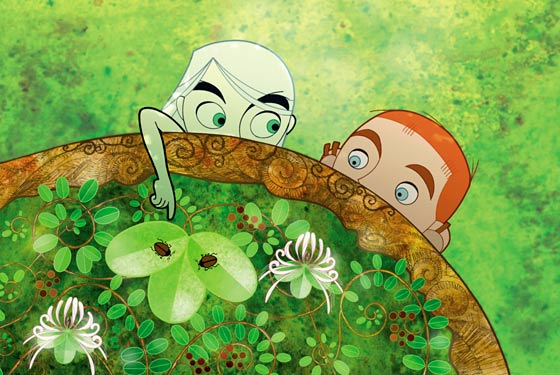
The story is about Brendan, a young brother in the Abbey of Kells in Ireland. His uncle, the Abbot, forbids Brendan from leaving the abbey and insists that he helps fortify the walls in preparation for the impending Viking raids. When the illuminator, Brother Aidan, arrives with his cat and unfinished manuscript, Brendan is suddenly encouraged to explore his more creative side and pay more attention to the natural world - which Aidan claims can teach more than any book. When asked to fetch an ingredient for ink, Brendan encounters the wolf spirit Aisling who befriends and helps him throughout the story.
Despite the presence of Christianity, the Pagan world is still alive in "The Secret of Kells." The Vikings are referred to as Pagans (which they were at this time). On some levels, the portrayal of the Vikings was unfortunate as they were shown as dark, almost infernal monsters. As they invade, one of them slashes through a cross - a scene that even made me sit up. One must remember, though, that the Irish probably saw the invaders as monstrous. Cromm Crúaich, a dubious Irish deity, is also in the film. There is mention of him in Irish lore - mostly in association with St. Patrick. Cromm is known for demanding the sacrifice of children for a good harvest. He is a very negative, demonic being in "The Secret of Kells." He's portrayed as a snake who, once dealt with, is drawn as an ouroboros - one of many spiraling symbols in the movie. What could be a negative portrayal of Paganism is balanced by the sidhe Aisling. She is the protector of the forest, a shape-shifter who, while friendly with Brendan, is also a hunter and a killer as a wolf. Aisling, to me, represents one of the best portrayals of a Pagan deity in modern culture. She is mischievous, powerful, and ageless yet benevolent to the deserving, and possessing of her own faults and weaknesses.

I highly recommend this movie to anyone who loves Ireland, mythology, or a good story. There are possibly some frightening scenes for children, so I recommend that parents watch it first if you're uncertain. If your child wasn't bothered by Disney's "The Princess and the Frog," he or she will probably love "The Secret of Kells." If you're concerned that your son or daughter will come away from the film with a poor impression of the Vikings, make sure to expose them to "How to Train Your Dragon" for a more positive representation.
( For My LJ Friends: http://adfcatprints.blogspot.com/ )
Saturday, October 9, 2010
Various Random Things From This Weekend - Probably Quite Boring *
I've had an enjoyable weekend so far. I was able to visit some of my family which is always wonderful. My husband was able to spend a lot of time with his best buddy and our future brother-in-law (I'll call him Hunter). Now that I'm older, I get along better with my sister (I'll call her Georgia). It's fun to to be with her and her fiance. It's always a very relaxed time, and Weretoad and I can be ourselves. They always have a new drink for us to try that further inhibits us.
We took advantage of the visit to finally unveil our new car to the immediate tribe. It's a lovely green hatchback with spectacular headlights which I like to think of as dragon eyes. In fact, I fancy the whole car a dragon (symbolically, of course). I've referred to it as a green dragon, but my husband cringes due to the drug reference. It's been very difficult living in the North Country with only one car - and an old one at that. We've already had some situations that made me feel uncomfortable and even helpless. The public transportation system around here is practically non-existent. There are buses that come to our area, but the hours are so limited that they don't fit into my husband's work schedule at all. I need to adjust my sleep habits so I have time to walk to work in the morning. I would really like to develop that habit as reducing my impact on Mama Earth is very important to me. We would have liked to find a hybrid, but they are out of our price range. We did a lot of research and went for something that achieves decent miles per gallon and can assist us in transporting the kayaks we're getting for Solstice.
Now that we have a new car, I'm thinking about creating a protection charm to hang in it. It will probably have something to do with Lugh. The Romans equated him with Mercury, a patron of merchants and therefore travelers. This opens up the possibility that the Celts (or at least the Gauls) saw him in this way too. In the Irish myths, Lugh has to travel to the Tuatha de Dannan before he is accepted by them (perhaps a stretch...). I have been praying to Lugh for protection on the road for years now and I feel that he has heard and helped me.
I spent some time this weekend working on my Samhain costume. I'm planning to be a forest fairy. I've got the pieces of the vest cut out and ready to be stitched together. I found ear tips this weekend but will have to paint them.
Finally, my husband found a Victorian card with a green fairy on it while we were browsing in an antique store. I absolutely had to have it. She's Victorian, but not as silly looking as most fairies represented in that era. I can't wait to display her on my wall.
* At least I'm writing a substantial post! I haven't done that in a week it seems!
( For My LJ Friends: http://adfcatprints.blogspot.com/ )
Thursday, September 9, 2010
Ahimsa and Druidism?
The fact that I'm a Druidic vegetarian quietly amuses me. My ancestors were Irish, Scottish, and Germanic! They ate mutton, haggis, and sausage! My ancient Irish ancestors looked to Druids for spiritual guidance - which often involved blood. On Samhain, the herds were culled before the hard, cold months. My ancestors were from Northern Europe. They were herders, raiders, hunters, and fishermen.
They would probably have a hearty laugh at me! Yet I understand that their world was different from my own. They had to eat meat and other animal products to survive. Animals were often raised more sustainably than they are today on their giant factory farms. My ancestors in the northern climes just didn't have the choices that the Mediterranean Pythagoreans, the Hindus, or the Jains had. Not to mention, my ancestors did many things that probably should not be done today anyway...
I've been a meat-free vegetarian for about as long as I've been a Pagan*. For me, the two are hand in hand but I've never been able to exactly express why. I've always known that a part of it has to do with a deep respect for nature. But that is only part of it. Carnivores and omnivores are also part of nature and I do not deny their place or rights. My spirit guide is a carnivore. My animal companions are carnivores. They have never expressed a desire to give up meat and I don't think it would be healthy to force it on them anyway**. But I feel like I have a choice, and I don't feel like it furthers me from the food chain. I am basically an herbivore. If my spirit animal doesn't eat me first, then I will die and be eaten by smaller things and go back to the plants I ate. As long as I am not in a survival situation, I feel quite content eating as I do.
An lj friend and fellow ADFer*** recently posted this article entitled "I Was Wrong About Veganism" by George Monbiot. Basically the author, who once insisted that Veganism was the only ethical response to the environmental, health, and food dilemmas of this world, takes back the statement and gives his reasons based on new statistics. He argues that going local and returning to traditional feeding methods is the best for the environment and the animals. I totally agree, and the article made me feel better about my recent decision to consume dairy products again, albeit with a nearly strict preference for organic and/or local. The rare bit of cheese I eat must be rennet free. (On a side note, I feel like Brighid, my patroness who has very close ties with dairy, kept bugging me when I gave it up. So yes, in a way I do feel spiritually obligated to eat some of her essence.)
My friend is one of many Pagans I know who argue that eating meat and eating local is a moral act, to use her choice of words. By eating meat she is imitating the Gods. I get that, and I'm not about to say they are wrong, horrible people - especially if they are eating sustainably harvested meat. And yet... I still don't feel compelled to eat it myself. I've never felt spiritually motivated or pushed to. Quite the opposite.
I recently started to read more about Hinduism and Jainism in my quest to better articulate what, exactly, drives me to live the way I do. I could call myself an ethical vegetarian (someone who is a vegetarian for ethical reasons), but that implies that people who do eat sustainable meat are unethical...which isn't right or healthy to assume, in my opinion. I do what I feel is ethical for myself. In my studies, I came to the concept of ahimsa which is Sanskrit for the concept of doing no harm. It is an interesting and complicated subject but I rather enjoy learning about it because a lot of it is what I believe for myself. My friend Parallax first helped me begin this process of articulation when she mentioned a thought she had had when she was a vegetarian - there is a difficult to express hierarchy, which is why many of us are somehow okay eating plants. But even so, I try to be as respectful to plants as possible, thanking them for their nourishment, asking for permission before I harvest them, and leaving gifts of nuts or drink when I do. Even then, I try not to take everything - just enough for myself and for the plant to further flourish. Turns out, Jains believe in this hierarchy and have organized it. It is quite interesting, especially in light of recent arguments that "intelligent" animals like dolphins, whales, apes, octopuses, and squid should not be eaten at all.
So what does all of this mean to someone following a Druidic path? In Irish lore, some people are under geasa - magical bound to do or avoid something. Fate. One famous geis belonged to Cuchulainn. Because of his practically totemic connection to dogs, he was spiritually forbidden to eat of their flesh. As fate would have it, he ended up eating dog (due to other geasa in place) and this was part of his undoing. Perhaps not eating flesh period is my own personal geis - my spiritual fate? Perhaps it is merely this life's lesson. I have already learned much from my journey of fruit salads and lentil burgers - integrity, compassion, empathy, acceptance, patience, creativity... So much. Perhaps in this life, I am not meant to eat the salmon of knowledge - instead I am to share the hazelnuts of wisdom with the salmon themselves.
*I gave up red meat when I was 8 so I've been a flexitarian or vegetarian of some sort for a very long time.
** It would totally fail anyway. My cats like catching flies waaaay too much.
*** I don't know if she wants her username floating out in the virtual ether so unless she wants official credit, I will respect her privacy.
( For My LJ Friends: http://adfcatprints.blogspot.com/ )
Tuesday, August 10, 2010
The Moon in Modern Druidism

I'll begin by looking at the ancient Celts. As always, it is important to note that we have little information on what the ancient Celts believed due to a limited amount of pre-Christian documentation. Most of what is known comes from artifacts, the contemporary writing of antagonistic leaders or outsiders, and Christianized Celts. Details from the last two sources, especially, must be taken with a grain of salt.
Pliny the Elder wrote about the Gaulish Druids. His work includes the famous piece about Druids harvesting mistletoe on the 6th day of the moon (Ellis, Celts 54). Jean Markale analyzed the symbolism of the harvest ritual, noting that the sickle used to cut the plant would have been reminiscent of the crescent moon (Markale 131). Modern Druids from the Henge of Keltria equate this with the first quarter and celebrate the Mistletoe rite on such evenings. They explain that "mistletoe was known as `all heal,'" and take advantage of such evenings to perform remedial ceremonies. They have a second lunar ritual, the Vervain Rites.
Our other lunar rite is the Vervain Rite. The time of this rite was also chosen from classical descriptions of ancient Druidic practices. It was written that vervain was gathered when neither sun nor moon were in the sky. This occurs sometime during each night, except when the moon is full. We generally celebrate this around the 3rd quarter. This gives ample time for the rite during the evening hours. It also places this rite opposite the Mistletoe Rite in the lunar cycle. Vervain is said to be of aid in working magic. Thus, the Vervain Rite is our time for working magic. The purpose of magic in a Druidic sense is more like prayer. We work magic to help effect change in our lives. Druidic magic may involve contemplation, meditation, ritual or ecstatic dance (The Henge of Keltria FAQ).Pliny's writing aside, there is more evidence that the moon was important to the ancient Celts. The Welsh Goddess Arianrhod may have been a lunar deity. Some look to Proto-Celtic linguistics and argue that her name means silver wheel - an obvious reference to the moon (Wikipedia). Others are less convinced due to the variability of her name (Mary Jones).
Cerridwen is another possible Welsh deity with lunar associations. Etymologically speaking, her name may mean "bent white one" (Mary Jones), a possible reference to the crescent moon. When considering the symbolism of her transformations, a lunar link could be possible.
The Coligny Calendar may be the most concrete example we have of lunar observation among the ancient Celtic tribes.
Produced before the Roman conquest of Gaul, this calendar is far more elaborate than the rudimentary Julian calendar and has a highly sophisticated five-year synchronisation of lunation with the solar year (Ellis, Druids 230).Peter Berresford Ellis also notes that Caesar and Pliny the Elder both commented on how the Gauls measured time according to nights and the moon.
Thus we have strong evidence for the moon as a time piece, but less on other ritual or magical significance. I am assuming that Carmina Gadelica will have more moon lore, albeit Christianized. The moon continued to play an important role in surviving folk magic which has inspired a plethora of modern magical traditions. The moon seems central to magical thought and I am hopeful to learn more.
Works Cited
Aranrhod ferch Don. 2009. Mary Jones' Celtic Encyclopedia. 10 Aug. 2010
<http://www.maryjones.us/jce/cerridwen.html>.
Arianrhod. 13 April 2010. Wikipedia. 10 Aug. 2010 <http://en.wikipedia.org/wiki/Arianrhod>
<http://www.maryjones.us/jce/cerridwen.html>.
Arianrhod. 13 April 2010. Wikipedia. 10 Aug. 2010 <http://en.wikipedia.org/wiki/Arianrhod>
Berresford, Ellis. The Celts A History. New York: Carroll and Graf, 2004.
---. A Brief History of the Druids. New York: Carroll and Graf, 2002.
Bonewits, Isaac. "Questions and Answers about ADF." Ár nDraíocht Féin. 10 Aug. 2010
<http://www.adf.org/about/basics/qa.html>.
Cerridwen. 2004. Mary Jones' Celtic Encyclopedia. 10 Aug. 2010
<http://www.maryjones.us/jce/cerridwen.html>.
<http://www.adf.org/about/basics/qa.html>.
Cerridwen. 2004. Mary Jones' Celtic Encyclopedia. 10 Aug. 2010
<http://www.maryjones.us/jce/cerridwen.html>.
Frequently Asked Questions. The Henge of Keltria. 10 Aug. 2010
Markale, Jean. The Druids Celtic Priests of Nature. Rochester: Inner Traditions Int., 1999.
( For My LJ Friends: http://adfcatprints.blogspot.com/ )
Tuesday, July 6, 2010
Mushrooms in my Garden
I've got a few tiny mushrooms in my garden. According to everything we've been reading, the veggies are safe and the mushrooms can indicate good soil and benefit the plants. The shrooms themselves are not edible but the plants will not be contaminated. We think they're conocybe albipes. Pretty neat!
In other news, my interest in herbalism has been resurrected. I've been attempting to study it more. I want to learn more about how the Celts thought about and interacted with certain plants. I'm looking for good source material. I've been meaning to read Carmina Gadelica and I know there will be some in that. But what else? I read a really great essay by Erynn Rowan Laurie called "Goddess of the Growing Green: Airmid of Ireland." It really inspired me. While at Alex Bay, I found a piece of driftwood and I'm thinking of using it to create an image of Airmid for a garden shrine. I already made a doll of Airmid, but she isn't suited to the outdoors.

How many of you are involved in herbalism? Any tips or resources you can recommend?
( For My LJ Friends: http://adfcatprints.blogspot.com/ )
In other news, my interest in herbalism has been resurrected. I've been attempting to study it more. I want to learn more about how the Celts thought about and interacted with certain plants. I'm looking for good source material. I've been meaning to read Carmina Gadelica and I know there will be some in that. But what else? I read a really great essay by Erynn Rowan Laurie called "Goddess of the Growing Green: Airmid of Ireland." It really inspired me. While at Alex Bay, I found a piece of driftwood and I'm thinking of using it to create an image of Airmid for a garden shrine. I already made a doll of Airmid, but she isn't suited to the outdoors.

This is an incomplete photo... Her shroud has more color now. :D
( For My LJ Friends: http://adfcatprints.blogspot.com/ )
Wednesday, May 26, 2010
Lost - One Pagan's Perspective on the Magical Finale

I was finally able to watch the finale of "Lost" on Hulu last night. I was really happy with the conclusion of the series. Hell, I loved the whole story - plot holes and all. More on that in a moment.
"Lost" had everything a typical Pagan would love: mythical references, characters who seem like protective spirits or deities, unique legendary creatures, ghosts, multiple worlds/universes/dimensions, a compelling story with wonderful characters, magic, and mystery.
That last characteristic, the mystery, is what has kept people watching for so many years. It's also what has some audience members up in arms in regards to the finale. Sure, some of the unexplained plot devices are a bit annoying. For example, where was Walt at the end? But for the most part, I can live without knowing a lot of the answers. In fact, I was happy that they didn't tell me where certain structures came from or how The Man in Black somehow lost his powers before his death. As I've already said to some people, most explanations would, I'm sure, feel contrived. And as someone who reads and revels in mythology, I am perfectly content with magic and mystery. Will we ever know the creation story of the Celts, for example? If we don't, we will be fine. In fact, it makes for a less dogmatic, more engaging religion in my opinion. A religion is not the same as a television show, at least not at this point in history, but I hope you see what I mean.
So what if we don't know what the numbers meant, who built the temple, the wheel, and the well which was the source of light? Isn't life full of mystery?
The final scene occurred in some sort of church but it wasn't of any denomination. The creators made sure that the camera scanned over several religious icons and tools - crucifixes, menorahs, Buddha, Krisnha, etc...- to show that the Otherworld/Purgatory environment everyone had created was beyond creed. Even in death, the characters did not know what the "right" religion was. The biggest mysteries of life in general were still unanswered. That dwarfs so much of the mystery of the island which, in the end, is a symbol for the macrocosm of mystery in life. Who are we? How did we become stranded on this planet and why? The adventures on the island, while seemingly so important, happened because of what people believed - and in the end we don't know which of those beliefs were correct. Everything is left up to human interpretation and, often, this led to error. In our own lives, we go through our day making offerings to Gods that appear to us but not to everyone. We feel that we are doing what is right but, in the end, who really knows? We play the lottery and we may win. Was it luck? Fate? Neither? Is that drink you consumed in your initiation ceremony full of magic and energy? Was it only in your head? We cannot know.
In the end, the characters, who struggled through so many moral mazes on that island, reach a point where they are able to let go and realize that the unanswered questions, the puzzles, and the rituals were only vehicles towards the bonds they formed with other people. That was the point of the show - to exhibit that despite all the uncertainties in our lives, one of the only significant things we can come close to understanding and really experiencing are the relationships we create with other people (and animals. Yay Vincent!).
I cried during the final scene. How poignant to imagine that, after everyone you love has died, you are able to come to terms with the hurt or the unanswered questions, and just celebrate what you did share and know together before moving on to new uncertainties to explore. To me it was very magical and optimistic.
[ For my LJ friends, please visit me at: http://adfcatprints.blogspot.com/ ]
Tuesday, May 4, 2010
In which I talk about a traditional Goddess chant and my Celtic version...
I did this yesterday after fooling around with iMovie for several hours. At first I just wanted to post an audio file I made using Garage Band, but that didn't work out as I couldn't figure out how to upload it to Blogger. I realized I could make a movie, post it on Youtube, and embed it on my blog. This is my first movie and is incredibly simple in that it's merely a picture of my altar, the title, and my audio. Be nice. :P
[ For my LJ friends, please visit me at: http://adfcatprints.blogspot.com/ ]
Sunday, May 2, 2010
Let me introduce you to Sif!
Sif is a Norse Goddess. She's Thor's wife and is known for her beautiful, golden hair.

Here is my interpretation of her. She's sitting in the forest with her horn of mead.

Here is a closeup of her sitting in a tree.
Sif is a one of a kind art doll and is not a toy due to some slight armatures, beading, and chains. She was so much fun to make and and I learned a lot as I went along.
[ For my LJ friends, please visit me at: http://adfcatprints.blogspot.com/ ]
Wednesday, April 14, 2010
In Which I Reflect on a Book

I finished Practical Magic in the Northern Tradition by Nigel Pennick this evening. I was really excited about this book at first. I really was. As stated in an enthusiastic post when I received it in the mail, I really liked the book he coauthored with Prudence Jones. I had high expectations; expectations that, past that visually offensive cover, I would learn so much.
Nope. Not really... What I thought was a contextual introduction turned into the entire book. Had I not already read so much about Pagan holidays, symbols, tools, etc, etc, etc, this book would have been wonderful. Now, I did learn some new things, but they were kind of trivial and/or not culturally specific. Everything else was subject matter presented in the above linked A History of Pagan Europe.
Pennick put most of his focus on Asatru despite the book's supposed focus on all of Northern Europe. It was Odin this, Thor that... This will be very helpful when comparing Druidism to Asatru, but I didn't learn anything knew about Celtic tradition. Pennick's often eclectic approach left me baffled and/or frustrated. He referred to Brighid, the Goddess, as a virgin even though she has a son in the Invasion myths. He even Wiccanized her with the maiden, mother, and crone/hag deal. That just isn't the case in Irish lore.
In the end, the book was kind of boring and, in general, a waste of time for me to read.
Saturday, February 20, 2010
Percy Jackson and the Olympians: The Story Thief

The film version, directed by Chris Columbus (the same director for some Harry Potter films), was kind of a let-down in that it was so different. Sure the basic themes were there:
1) A coming of age story about a kid who discovers he's the son of Poseidon.
2) Absent parents often leave children feeling insecure.
3) The Gods are still around and influencing our culture.
However, the story was really different. For starters, simple yet important plot elements were never discussed. An unfamiliar audience may not realize that Percy's sword/pen is supposed to return to his pocket no matter what. It was never explained *why* Olympus was in NY City rather than Greece. Clarrise wasn't there at all. Neither was Dionysus! Even Grover's life goal, something incredibly important to later books, was left out.
Grover seemed like a vastly different character. He was my favorite in the books. He was insecure, always hungry, and was very concerned with the environment. He was funny because he was geeky and adorably awkward (for a Satyr). In the movie he was reduced to the wise-cracking side-kick who occasionally "maaa-ed" and ate a can. Although Grover had an eye for the nymphs in the books, he didn't act like a playboy. I also can't imagine Grover dancing on state to Lady Gaga's "Poker Face."
Which brings me to the major plot change. Ares doesn't show up *at all*. The half-bloods don't even go on an official quest given by the oracle - they run away. Chronos has nothing to do with it. The Titans are mentioned ever-so-briefly in a museum but, otherwise, everything gets blamed on poor old Hades. Now, in the books, Hades isn't exactly the nicest guy, and he does desire a paradigm shift, but he wasn't made to look like the Christian Satan and he didn't want a war. In the movie, Hades first appears looking like a molten Chernabog from Disney's "Fantasia." WTF?! Hades is *never* described like that in the novels let alone Greek mythology. He later appears in a more human form - albeit dressed like some sort of punk rocker (lol). In the movie, Persephone was with Hades. In fact, they changed the entire plot so that the kids were looking for "Persephone's pearls" spread all over the US, left for would-be boyfriends to find as a gateway into the Underworld. First of all, this takes place in the spring and summer - Perseophne isn't supposed to be in Hades then! The pearl thing?! Where did they pull that from?! Why couldn't they have stuck with the original plot of the book?! Changes like that make me so angry.
Plot aside, it was fun to see the characters brought to life. The satyrs and centaurs looked amazing. But there were so many things missing... I would have liked to see Clarrise. She's an interesting character, especially later in the series. Annabeth (in the movie) seems to be a combination of her book counterpart and Clarrise, the warlike daughter of Ares. I was *really* looking forward to seeing Dionysus only to be disappointed. He's so grumpy and (to me) lovable in the books. I was let down by his absence as camp director.
If you haven't read the books, you may still enjoy the movies (plot holes aside). The children in the audience definitely liked it. My husband heard one exclaim "This is the best movie ever!" Maybe s/he doesn't get out much? It was entertaining but, if you're really curious about Percy Jackson, I recommend the books.
Wednesday, January 13, 2010
ADF Chats and Strange Dreams
I found out that the CUUPs group in Watertown was having a meeting last night. At first I really wanted to try and make it but then I realized how last-minute it was and decided to stay home and relax with my husband. I ended up getting on the ADF chat towards the end of the night which was a lot of fun and helped to remind me that I'm not alone, even if I'm the only ADFer in Northern NY (which it sometimes seems is the case...) We talked about the nature of deity, specifically whether or not Zeus was the same as Jupiter and Tyr, etc. It was a fun intellectual exercise but one we all agreed wouldn't lead to any true conclusions. All the same, I believe that such discussions are important. They force us to contemplate our faith and even question it. This, I believe, helps to ward off stagnation and unflinching dogma.
Somehow, we ended up talking about the Fomoire, I admitted that I had an interest in them, in particular Bres. In much of the lore I've read, he is Brighid's husband. Unfortunately, he turns out to be a horrible king. Bres is part Fomoire and part Tuatha de Dannan. He decides to enslave the de Dannans and favor the Fomoire. He was also not very hospitable which, to the ancient Irish, was a big no-no. After a war, The Fomoire are defeated and Lugh gets the secrets of agriculture from former king Bres. It's a trade - Bres' life for, basically, the secrets of taming nature.
I explained to my fellow ADFers that, while I've not made tribute to him and do not worship him, I have an interest. Perhaps I can compare it to the interest people have in someone like Iago from Othello. He's the antagonist and I can't help but wonder at his motives. More importantly, I wonder at Brighid's relationship with him. Yes, in the myths, it was most probably symbolic of a political marriage and, perhaps, sovereignty. But, if the Gods have feelings like us, how did she feel? If it's all just a metaphor, what does it mean to people devoted to Brighid? What does it mean to a feminist to worship a Goddess who married an asshat? Was he always like that? We know she invented keening when their son was killed. But that's it. Brighid is such an important Goddess to me that I can't help but wonder at it all.
Anyway, shortly after the chat I went to bed and I had a horrible dream. In the dream, I became aware of a shadowy figure watching me through the windows at night. No matter where I went he (because I somehow knew it was male) knew and fallowed. At some points he was just a silhouette behind a blind. Other times I felt his presence. Then there were times when he seemed to be reaching through the windows from the darkness. It was very frightening. Finally, in an attempt to flee I got into a car with someone else (I can't remember who - my sister, maybe) and the person/thing chased after me. The car was going and I couldn't get the door closed. The thing was at the door, a shadow, reaching through the spaces. I woke up shortly after that.
At work I ended up daydreaming for a bit. I was thinking about the dream. I hardly ever seem to remember my dreams and I suddenly remembered the discussion on the Fomoire. Was it Bres? Or was my mind still thinking of the "Outsiders" ( the term we often use in ADF to describe the "powers of chaos" like the Fomoire or the Titans)? Did I get their attention? If so, and if I had a dream like that as a result, I don't think I'll ever want to think about making offerings to Bres.
Tonight, as it gets darker, I think of Brighid, my patroness, and I ask her, as I always ask her, to protect my home and me in it. I can't help but wonder what it means to ask the wife to keep the husband out?
Monday, December 28, 2009
Percy Jackson and the Olympians: The Lightning Thief

A month or so ago, an upcoming movie was brought to my attention - "Percy Jackson and the Olympians: The Lightning Thief." The plot sounded interesting and I'm a sucker for anything involving mythology. Although I consider myself a liberal Celtic Reconstructionist and NeoDruid, Greek mythology will always have a special place in my heart. It was what I was first exposed to. Indeed, my favorite Saturday Morning Cartoon was a series of animated Greek myths!
When I found out that the movie was based on a book I decided to find it and read it. I'm a bit out of touch with juvenile fiction. As an English major I was far too busy reading old classics to have time to read anything else! When I had free time to read what I wanted, I found myself reading history and NeoPagan studies. As a college grad with some time on my hands, I decided to give it a try and I'm glad I did.
The first book, which shares the movie title, follows the adventures of Percy Jackson, the son of Poseidon, and his friends as they race to recover Zeus' stolen thunder bolt to its rightful owner in order to prevent a massive war. The book, in my opinion, is Harry Potter meets American Gods. There is a world of mortals and a world of Gods, monsters, and Godlings or half-Gods. This classification is the witch/wizard and muggle world of Harry Potter, I suppose. The Godlings even have a special place to go in the summer called "Camp Half-Blood" where they learn to be better heros (because that's what people with divine parents naturally become!). It reminds me of Gaiman's wonderful book because the Gods are very much alive, interacting with the mortal world, and have modern touches. Poseidon, for instance, wears a beach shirt and his throne looks like a fisherman's chair. Whimsical touches like that really make the book enjoyable.
The colloquial first-person narration was, at times, annoying, but that could stem from the fact that I generally don't read juvenile fiction. I did get used to it but there were times when it was a bit jarring. The story was fun but some elements were predictable (or didn't add up to the mythology I studied in college - but most of it was really well done). That said, I can't wait to read the next one! It was a relaxing and enjoyable read. I can definitely see myself reading it to any children I have.
Subscribe to:
Posts (Atom)